
NEWS
Launch of Boarding and Landing Code PPE annex
News |Published: Nov 18, 2026
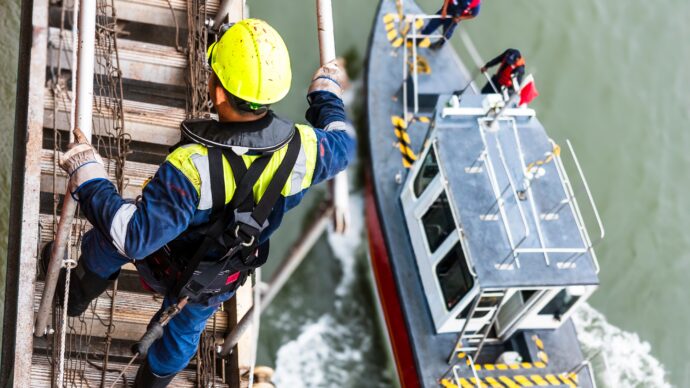
Port Skills and Safety has supported the development of an annex to the Boarding and Landing Code which covers Personal Protective Equipment (PPE) for cold-water survivability.
The revision is part of a joint response to the MAIB Recommendation 2026/106, from the Humber Saturn / Finnhawk very serious marine casualty safety investigation report into the 2023 pilot fatality incident.
PSS, along with the UK Marine Pilots Association, UK Harbour Masters Association, UK Major Ports Group and the British Ports Association, were recommended to jointly update the Embarkation and Disembarkation of Pilots Code of Safe Practice to include guidance to Competent Harbour Authorities (CHAs) on the setting of occupational health standards for UK maritime pilots, and the provision of suitable personal protective equipment (PPE) for pilots to improve their survivability in cold water.
What Annex 4 covers
Annex 4 is advisory. It supports each CHA’s own risk assessment, which remains the basis for all decisions on PPE. It draws on research by the UKMPA Technical and Training Committee, including a national survey of 103 pilots, harbour masters, and marine managers across 40 pilotage districts, an in-water evaluation of a range of products and configurations, and a review of the relevant standards and the published physiology of cold-water immersion.
Its guiding principle is to Reduce the consequences of accidental cold-water immersion (cold shock, cold incapacitation and hypothermia) as far as reasonably practicable, without a net increase in the overall risk of the transfer, including the risk of a fall from the ladder.
It sets out the cold-water hazard, a risk assessment based on water temperature and expected rescue time, an indicative PPE level from 1 to 4, and guidance on selecting, testing and maintaining equipment.
Recommended actions now
CHAs, working with their pilots, are encouraged to:
- Read Annex 4 alongside Annex 2 of the Code.
- For each boarding position, establish the seasonal water temperature band (using local data where available) and a realistic expected rescue time (using recovery drill evidence where possible).
- Consider first whether recovery capability can be improved, as this is often the most effective control.
- Use the matrix to find the indicative minimum PPE level for each position and season, and compare it with the PPE in use, bearing in mind that more protection is not always safer (A4.13).
- Where changes are indicated, select equipment designed for marine use and test it locally as a complete system with the pilots who will wear it.
- Provide training for any new PPE and agree arrangements for its maintenance and replacement.
- Record the reasons for decisions, and review them periodically and whenever the season, pilot boat or recovery arrangements change.
Occupational health standards
Work on the outstanding recommendation – the setting of occupational health standards for UK maritime pilots, continues into 2027.
Annex 4 can be downloaded below.